SecurityCourse project2026
Keystroke Dynamics
Can AI-generated text be typed out with a human rhythm? A typing simulator built from 99 real typists, tested against the detectors meant to catch it.
- 99
- Real typists in the dataset
- 0.982
- Detector F1, Random Forest
- 56%
- Simulated windows that passed it
Timeline
Winter 2026 term
Role
Research design, ML pipeline, simulator and demo
Team
Solo
Domain
Cybersecurity · Biometric authentication · AI-text detection
Status
Course project
Stack
Source
Section 01
Overview
Detectors for AI-written text usually look at the words. A second line of defence looks at how the text was typed: real people have a rhythm of key holds, flights between keys and pauses that a paste or a bot does not. Keystroke dynamics is also used as a behavioural biometric for authentication.
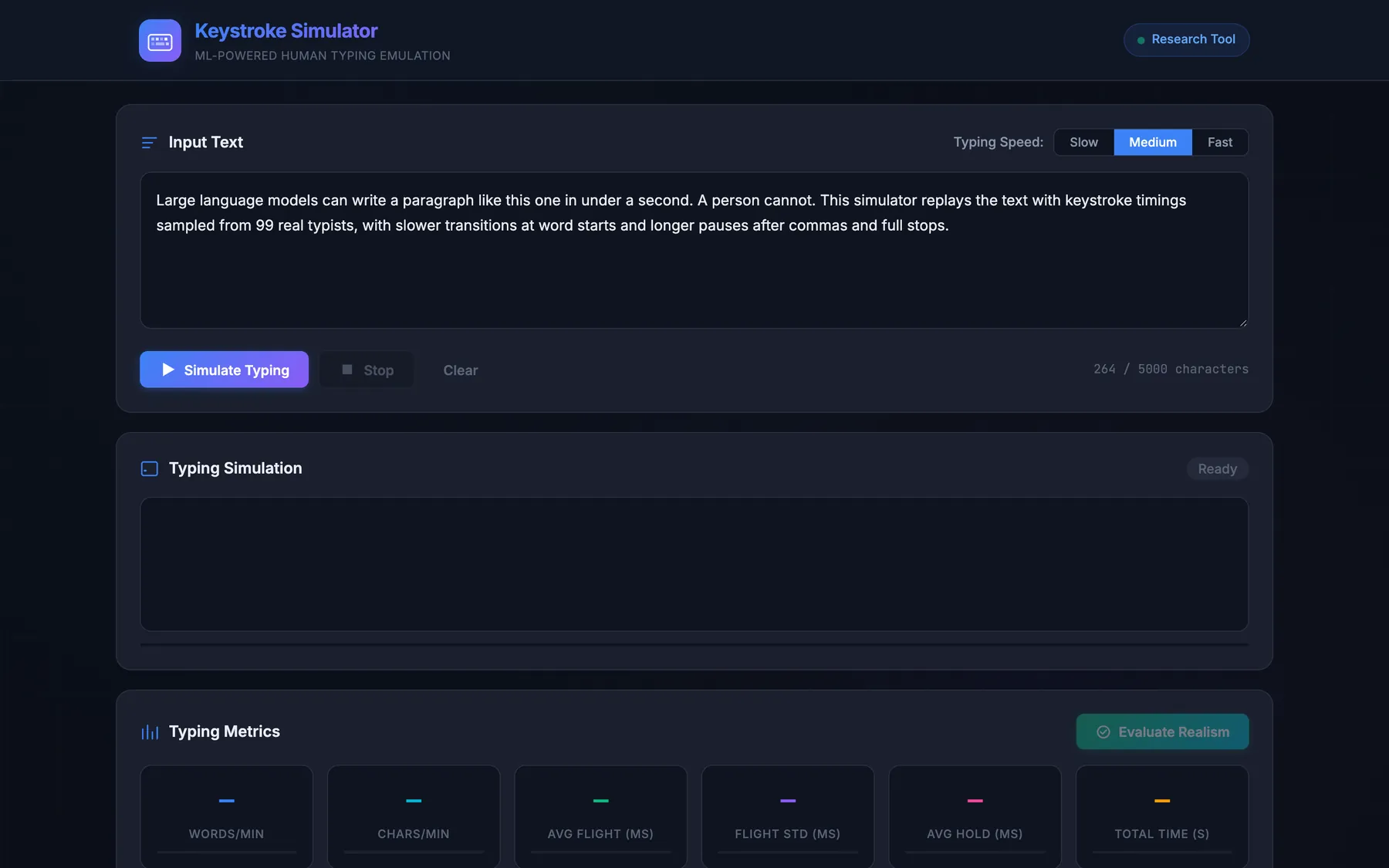
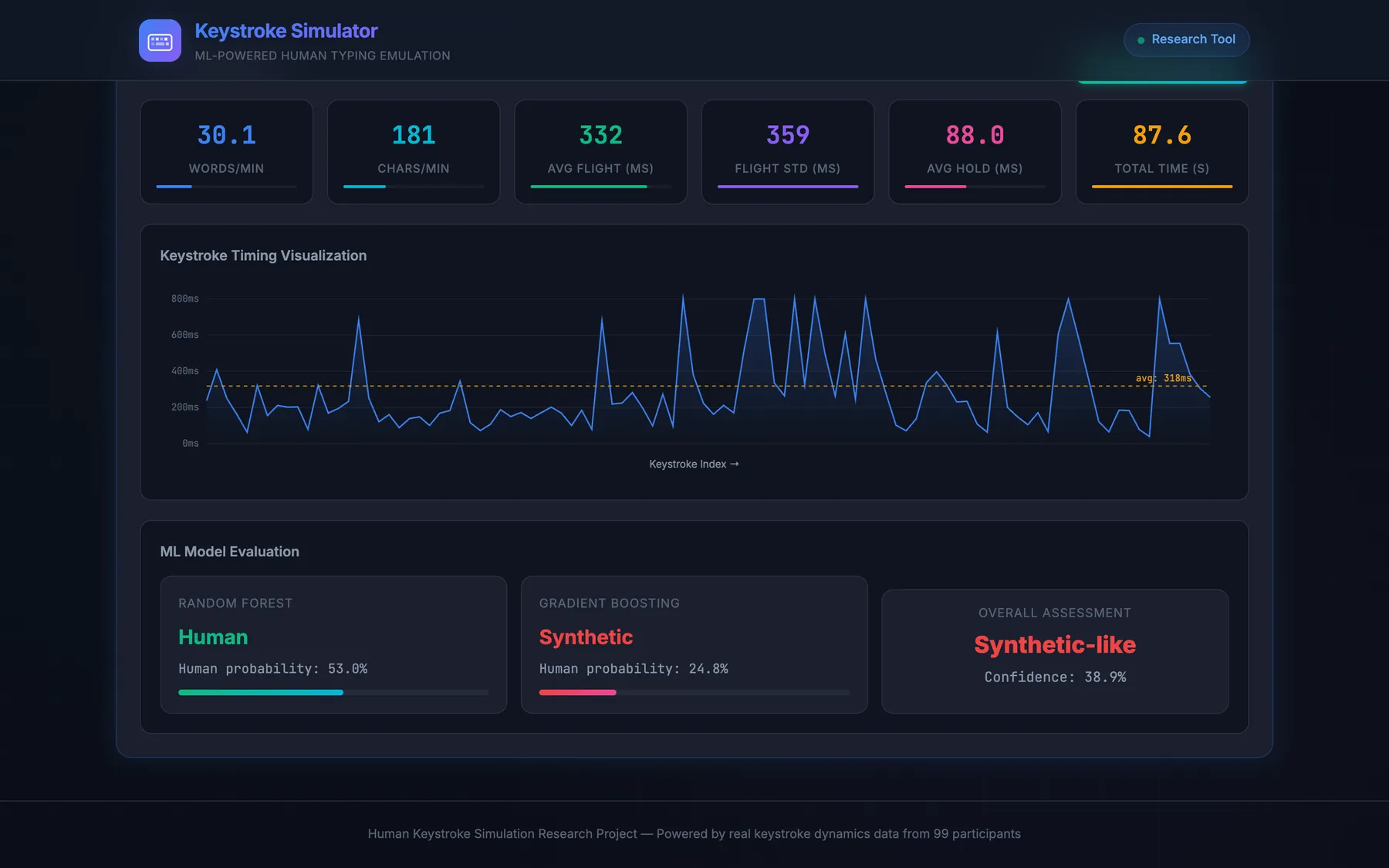
This project asks whether that defence holds. I built a simulator that types any text with timings sampled from real typists, trained detectors to separate human from synthetic typing, and measured how often the simulator gets through. A Flask demo replays the simulated typing live and asks the detectors for a verdict.
Section 02
What Human Typing Looks Like
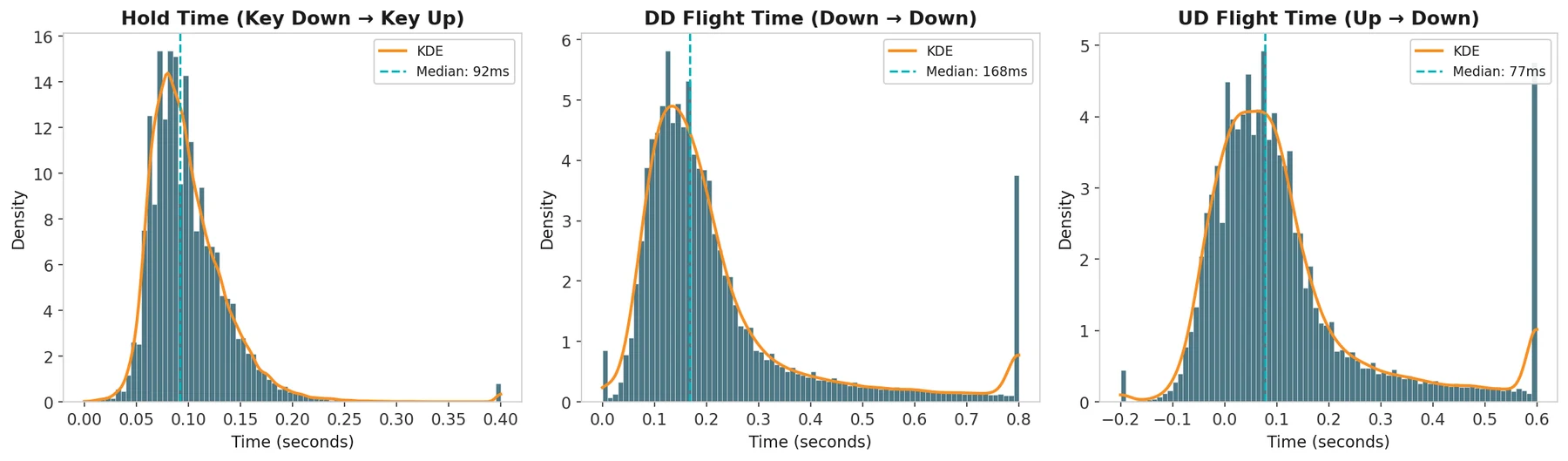
The data is the KeyRecs free-text dataset: 99 participants, two sessions each, 562,583 key-pair records. Cleaning removed nulls, corrupted rows and pauses over 10 seconds, leaving 559,485.
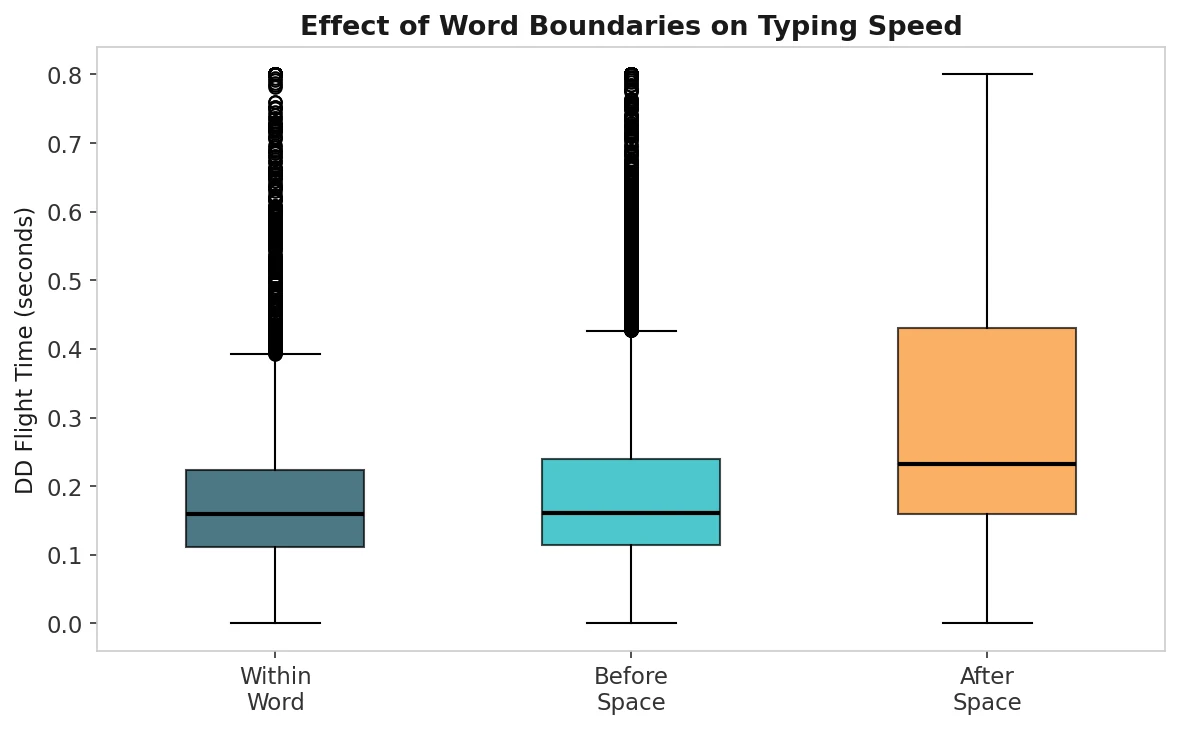
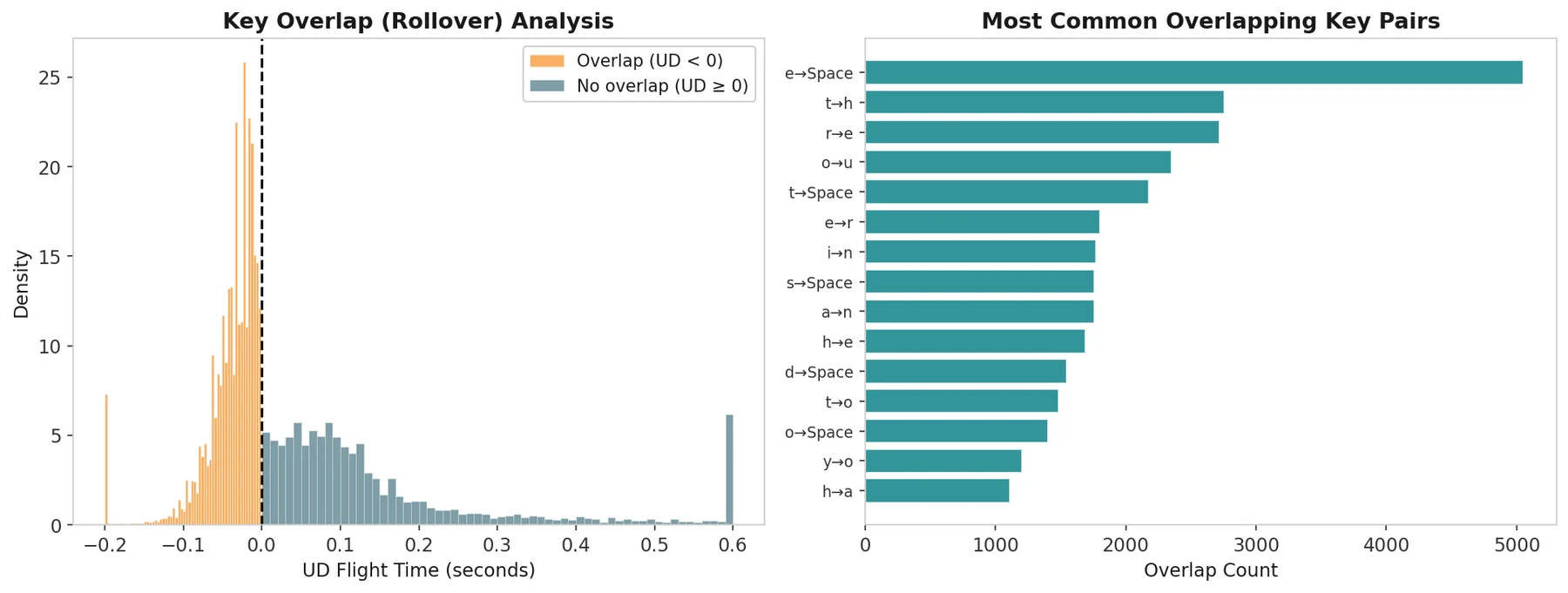
Three patterns shaped the simulator. Starting a new word is the slowest transition, about 53% slower than typing inside a word (241 ms against 157 ms median). Typists differ by 3.8x in median speed. And 17.2% of transitions are rollovers, where the next key goes down before the last one comes up.
Section 03
The Simulator
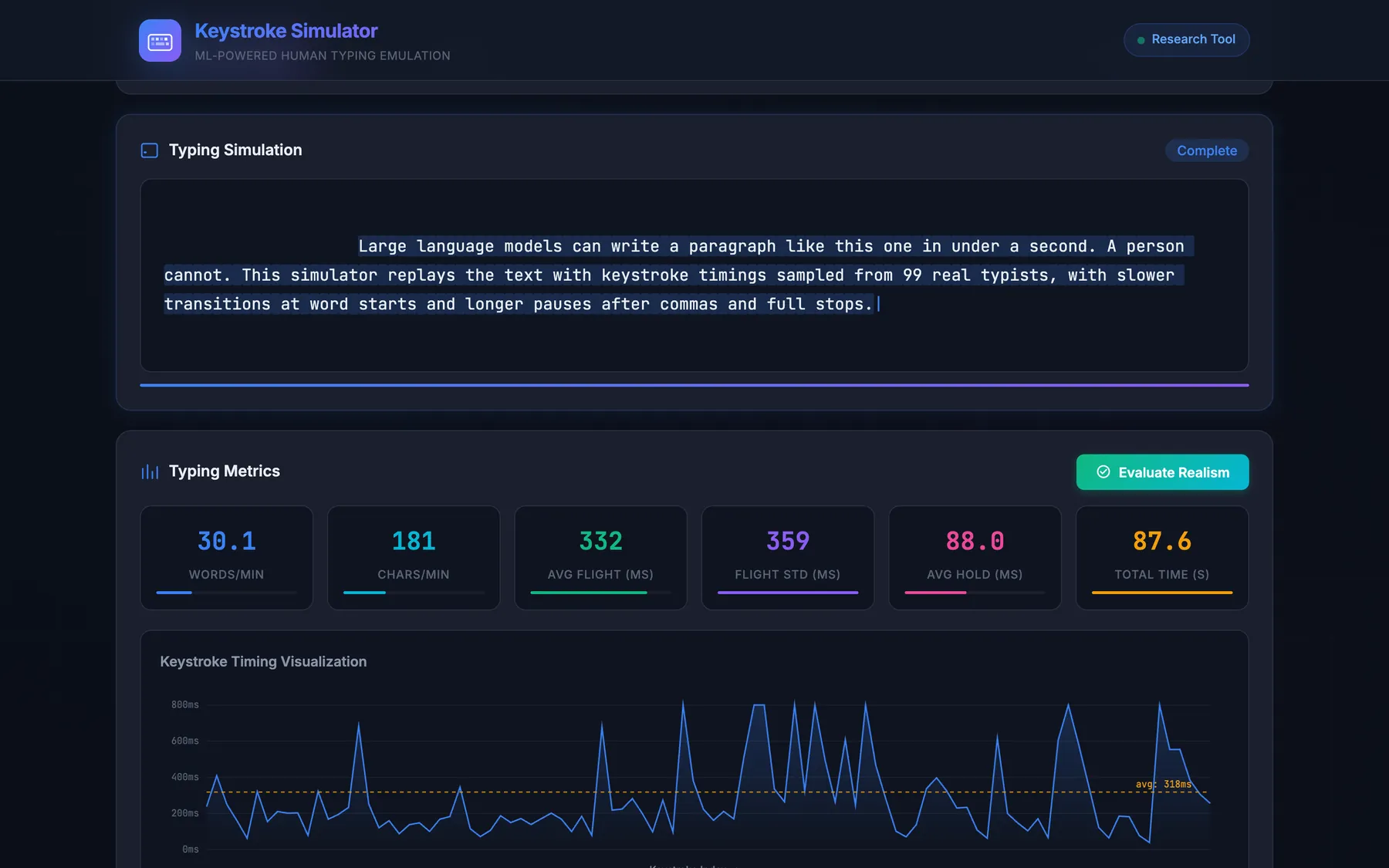
For each character, the engine samples a flight time from the distribution fitted to that specific key pair, then adjusts it for context (word start, mid-word, word end), the chosen speed profile and slow fatigue drift. It blends each new flight with the previous one so rhythm has momentum, and adds thinking pauses after commas and full stops. Hold times are sampled per key.
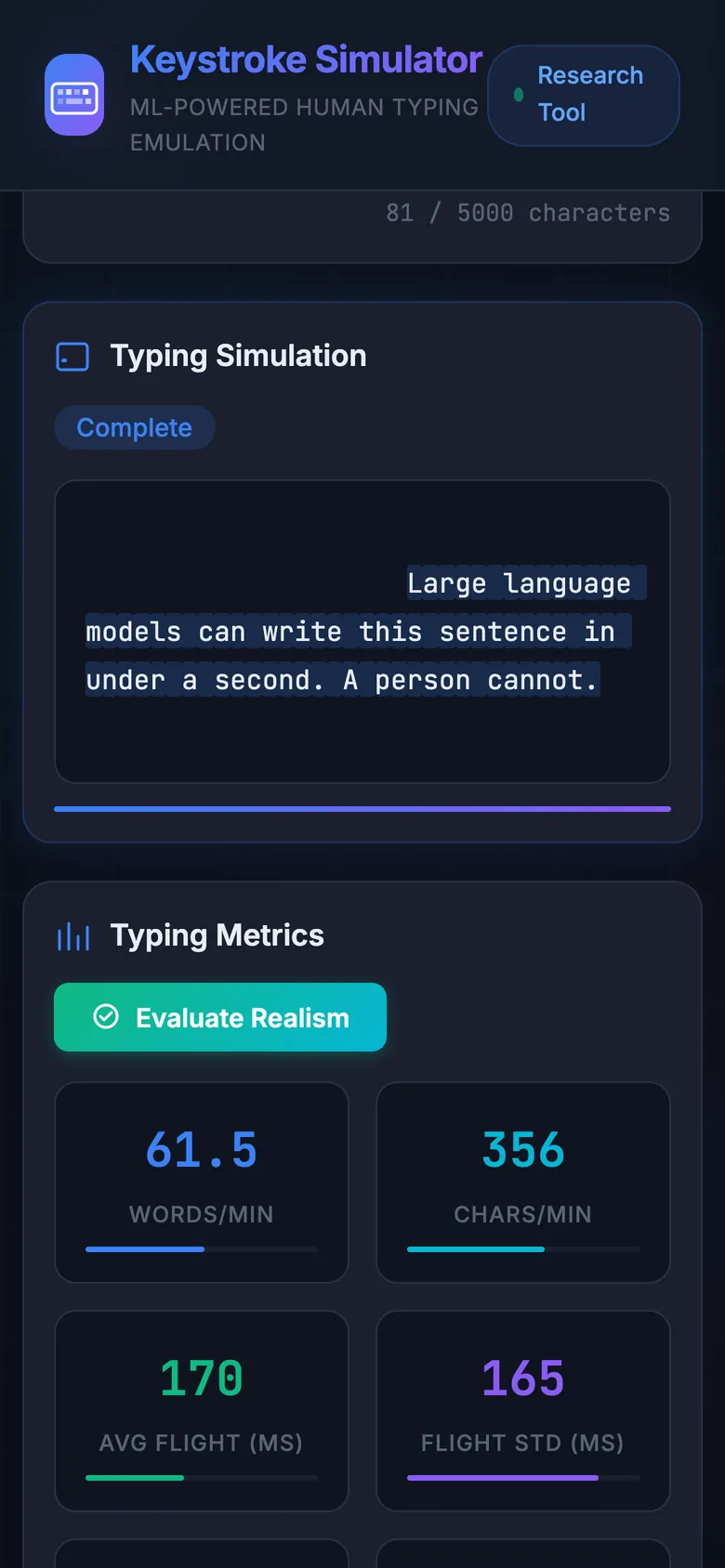
The output is a full keystroke stream with key-down and key-up times, which the demo replays in real time while charting every flight.
Section 04
Detection
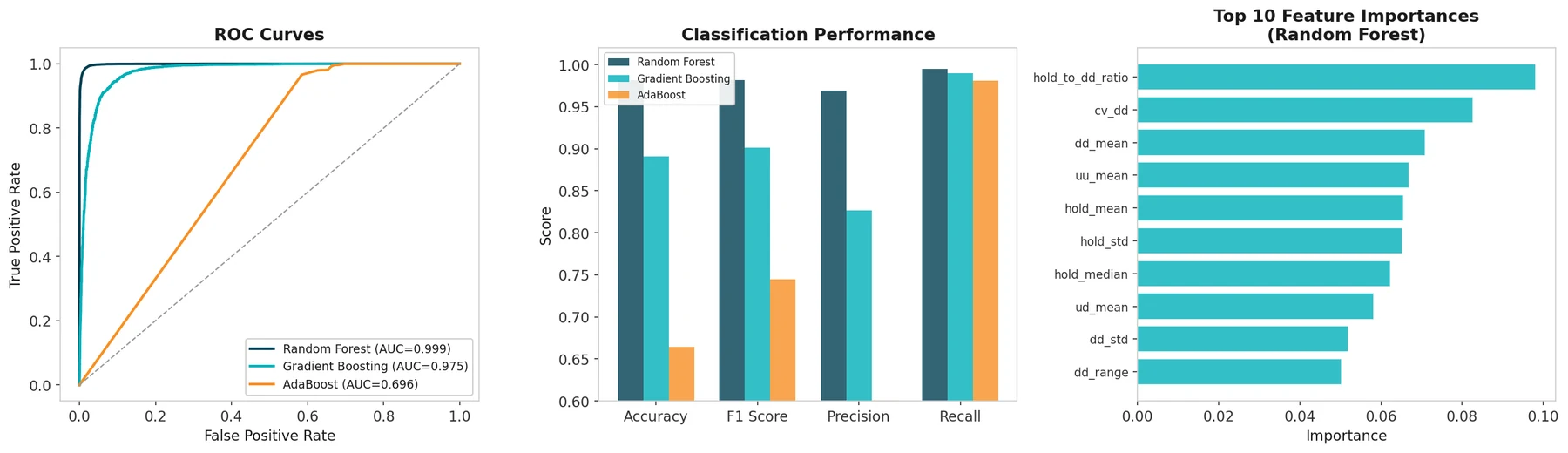
Detectors see 19 features computed over windows of 20 keystrokes: flight and hold statistics, their variability, rollover ratio and hold-to-flight ratio. I trained Random Forest, Gradient Boosting and AdaBoost on 26,430 human windows.
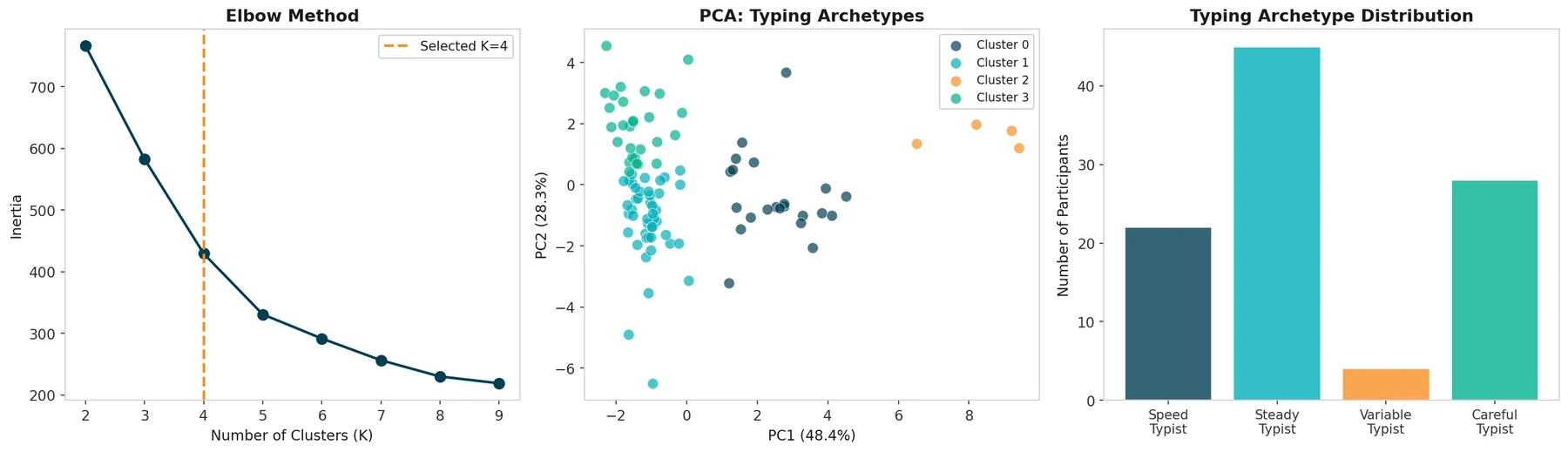
The first version scored almost perfectly, which was the warning sign: its synthetic negatives were too easy to separate. I rebuilt the negatives from statistical mimics, independently resampled features and noise-perturbed human windows. On that harder task Random Forest reached F1 0.982 and AUC 0.999, Gradient Boosting 0.901 and AdaBoost 0.745. K-Means on the participants found four typing archetypes, from steady to fast-and-overlapping.
Section 05
Results
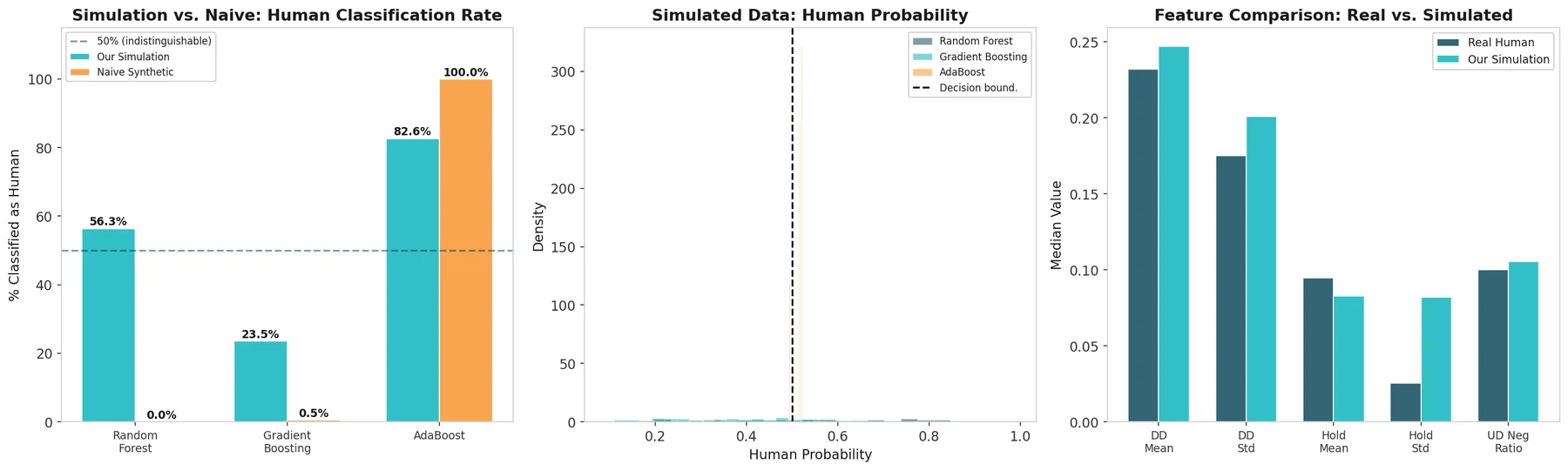
Against the strongest detector the simulator is close to a coin flip: Random Forest called 56.3% of simulated windows human. Gradient Boosting caught most of them, passing only 23.5%. AdaBoost passed 82.6%, but it also passes 100% of naive synthetic typing, so that number says more about AdaBoost than about the simulator. Naive synthetic typing was caught almost every time by the two strong detectors (0% and 0.5% passed).
Section 06
What Gave It Away
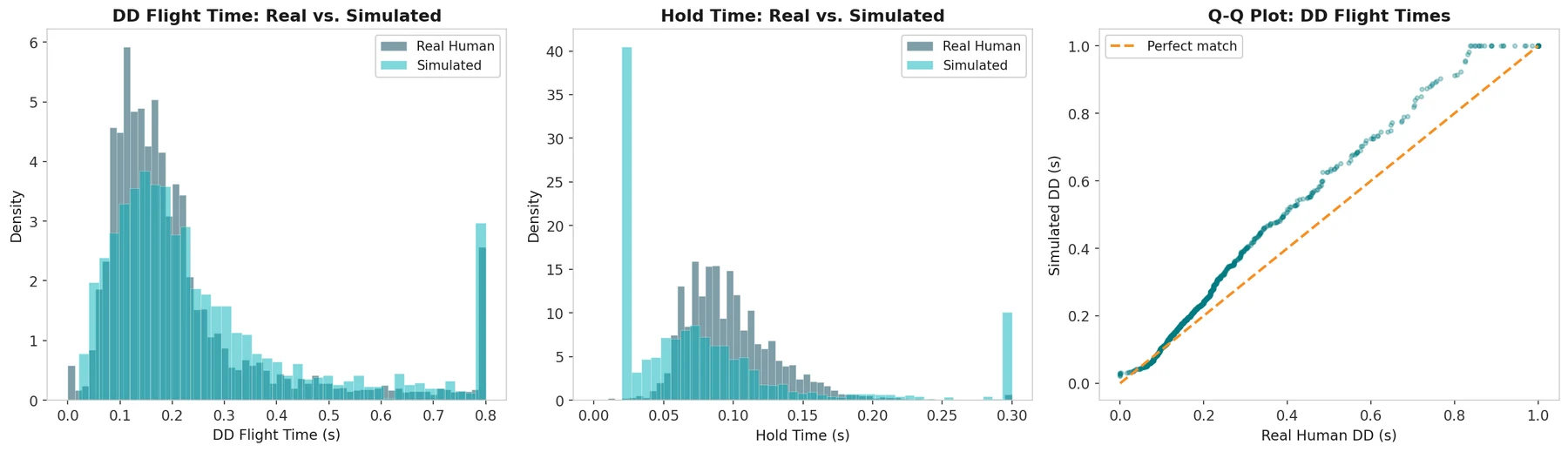
My report attributed the misses to rollover, which the simulator does not model explicitly. Going back to the outputs, rollover was actually close to human, because short sampled flights overlap long holds on their own. The clearer tell is hold time: some fitted distributions were degenerate, so about 18% of simulated holds sit at the 20 ms floor, and hold features are four of the Random Forest's top seven.
The fixes are concrete: refit holds with a fixed location or sample them empirically, add typos and corrections, and train detectors on keystroke-level synthetic streams instead of synthetic feature vectors.