AI / MLPrototype2026
Bastion
An event-driven portfolio risk platform for fund managers, built capital-preservation-first: every incoming headline is read by an LLM, scored by Jev for every exposed holding, run through a transparent risk calculus and pushed to the manager's phone, with the full reasoning chain one click away.
- 8.9 s
- Ingest to phone push, measured
- 202 ms
- Jev scoring per event, measured
- 22
- Breaking-news stress presets
Timeline
Oct 2026
Role
Design, risk pipeline and front end
Team
Solo
Domain
Fintech · Portfolio risk · Decision support
Status
Prototype
Stack
Section 01
Overview
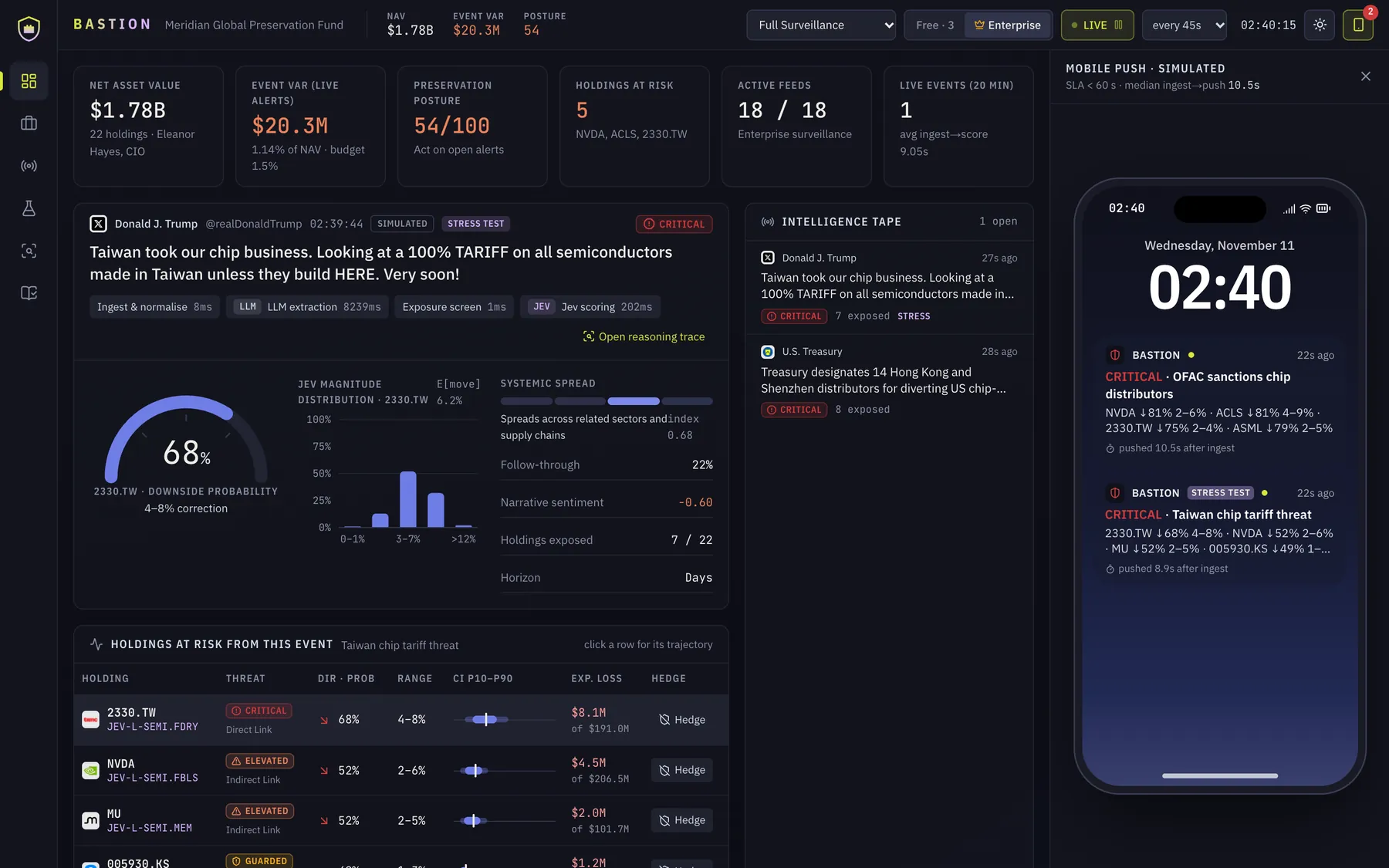
Bastion asks what a risk desk would look like if capital preservation, not alpha, were the organising principle. It watches 18 intelligence feeds for a simulated $1.78B fund, and every headline that lands is checked against the book: who is exposed, how bad could it get, and does the manager need to know right now.
Everything in the prototype is honestly simulated, and says so on screen: the news posts, the prices, the hedge orders. What is real is the pipeline: live Claude extraction, live Jev scoring, a deterministic risk calculus and a push console, all traceable end to end.
Section 02
The Pipeline
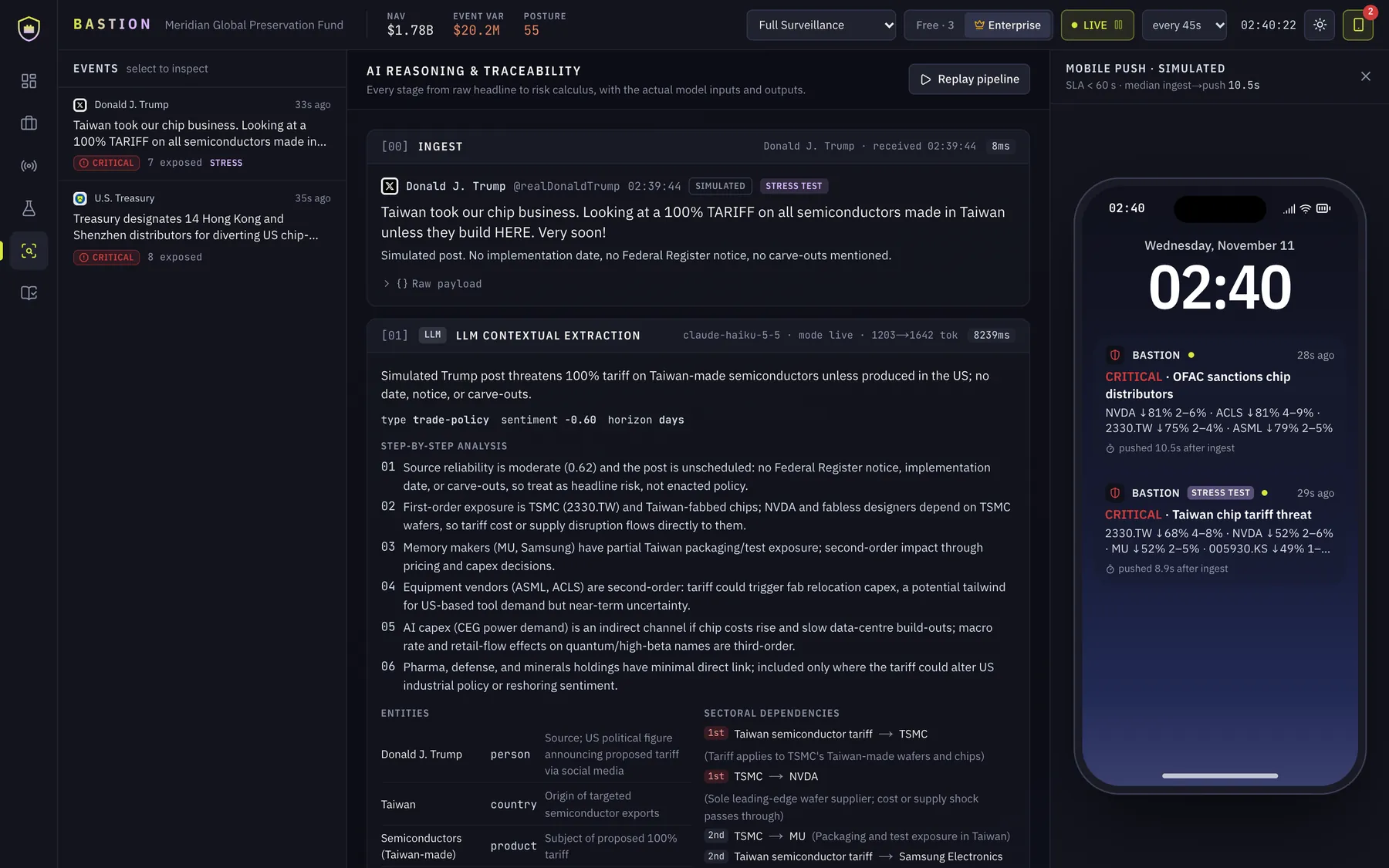
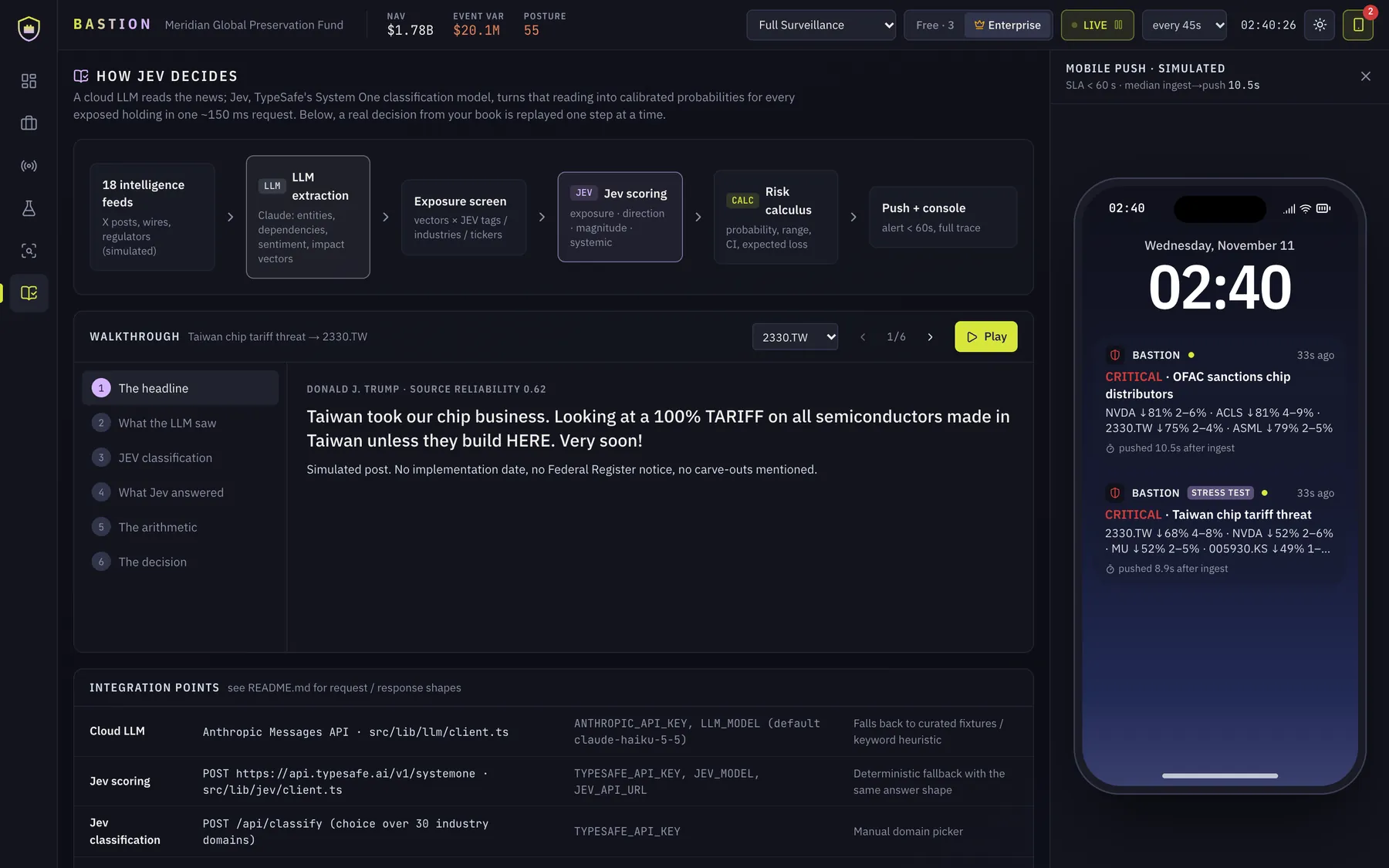
Each event runs a six-stage pipeline: ingest, LLM extraction, exposure screen, Jev scoring, risk calculus, push. Claude Haiku reads the headline against the book and returns entities, sentiment, auditable analysis steps and impact vectors in the platform's tag vocabulary. The screen matches vectors to holdings deterministically, so a vector targeting fabless semiconductors also catches a holding added next week.
Jev, TypeSafe's decision model, then answers typed questions for every exposed holding in one batched request: exposure, direction, and a magnitude distribution over move buckets, plus two portfolio-level questions. Measured on screen: extraction 8.2 s, exposure screen 1 ms, Jev scoring 202 ms, and ingest to phone push in 8.9 to 10.5 s against a 60 s SLA.
Section 03
Risk Calculus
The probabilities become numbers through a pure, inspectable function rather than another model call: exposure weights blend Jev's direct, indirect and peripheral probabilities, an event factor folds in source reliability and follow-through, and expected loss multiplies position size, expected move and probability. Confidence bars show the P10 to P90 of Jev's magnitude distribution, not a point estimate.
Event VaR sums each holding's worst live residual loss, with live events decaying over 20 minutes as they get priced in. The fund's preservation posture maps VaR against a 1.5% drawdown budget, so one number tells the manager how close the book is to its limit.
Section 04
Stress Lab
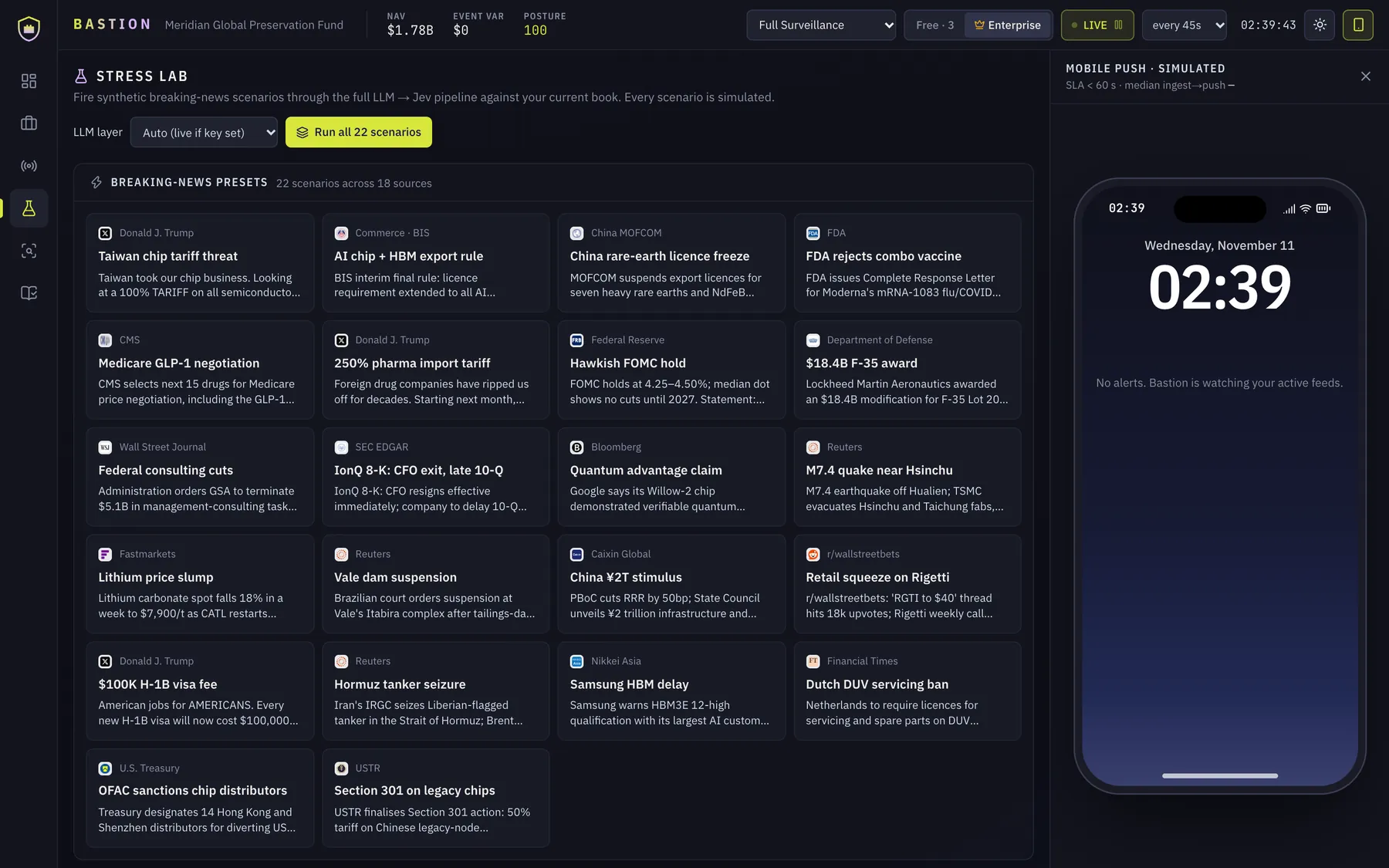
The Stress Lab fires synthetic breaking news through the full pipeline against the current book: 22 presets across tariffs, export controls, FDA decisions, rate shocks and defense budgets, plus a composer for custom headlines. Stress tests never touch the live book, and a league table ranks scenarios by expected loss.
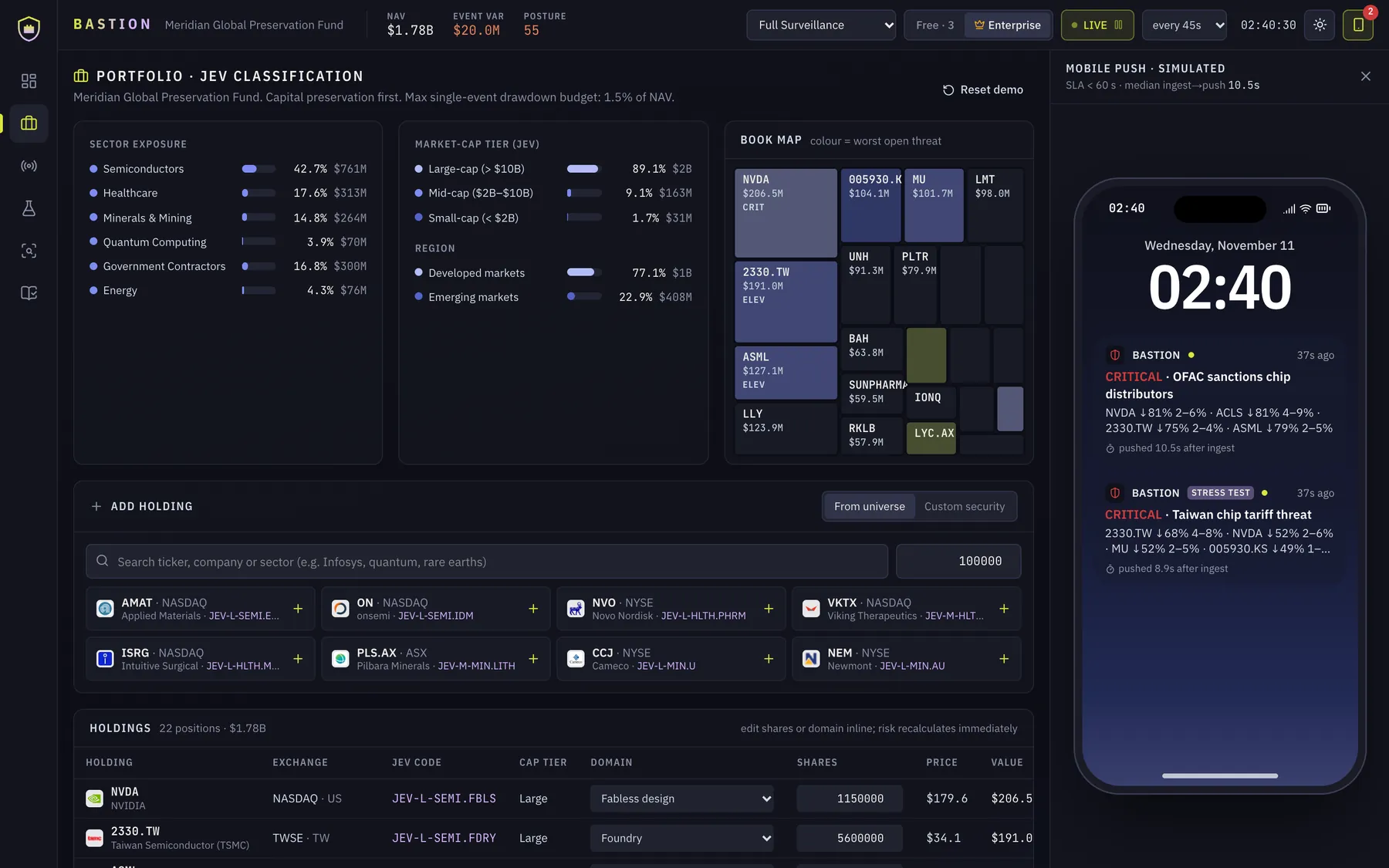
The portfolio page closes the loop: add any of a 40-name universe or define a custom security, and Jev classifies its industry domain live while open events are re-scored for the new name.
Section 05
Results
Bastion is the most complete systems-design piece in this archive: two model APIs, a deterministic core you can audit, honest simulation labels everywhere, and latency measured against an SLA rather than asserted.
- Six-stage pipeline with every stage timed on screen: 8 ms ingest, 8.2 s extraction, 1 ms screen, 202 ms Jev scoring
- One batched Jev request scores every exposed holding, with P10 to P90 ranges instead of point estimates
- Ingest to phone push measured at 8.9 to 10.5 s against a 60 s SLA
- Fallbacks at every model boundary, and a trace console that shows which mode actually ran